
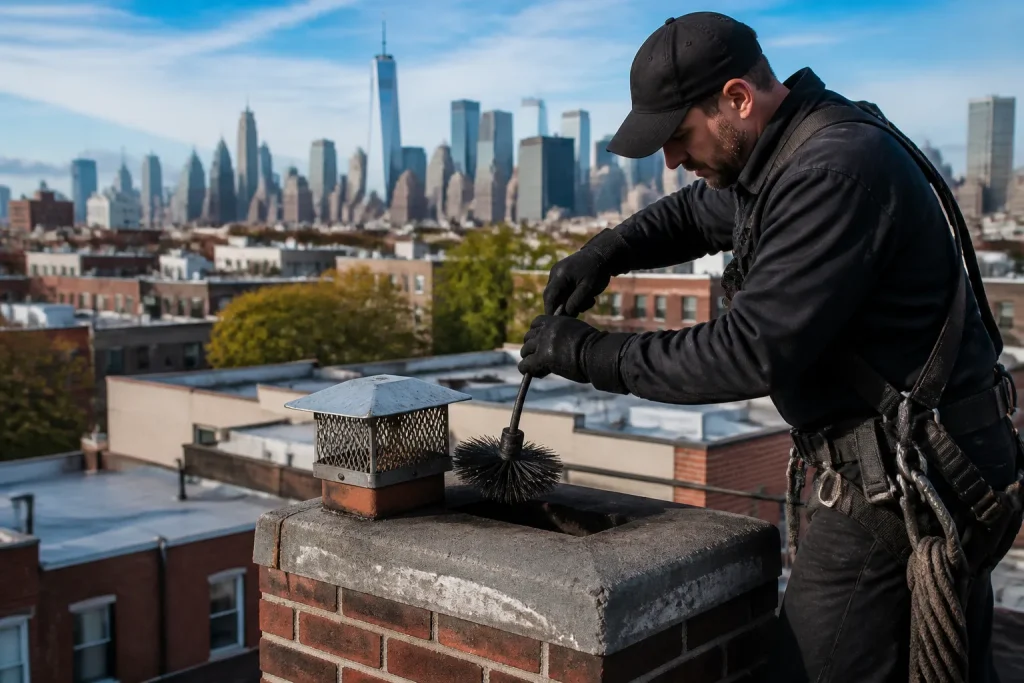
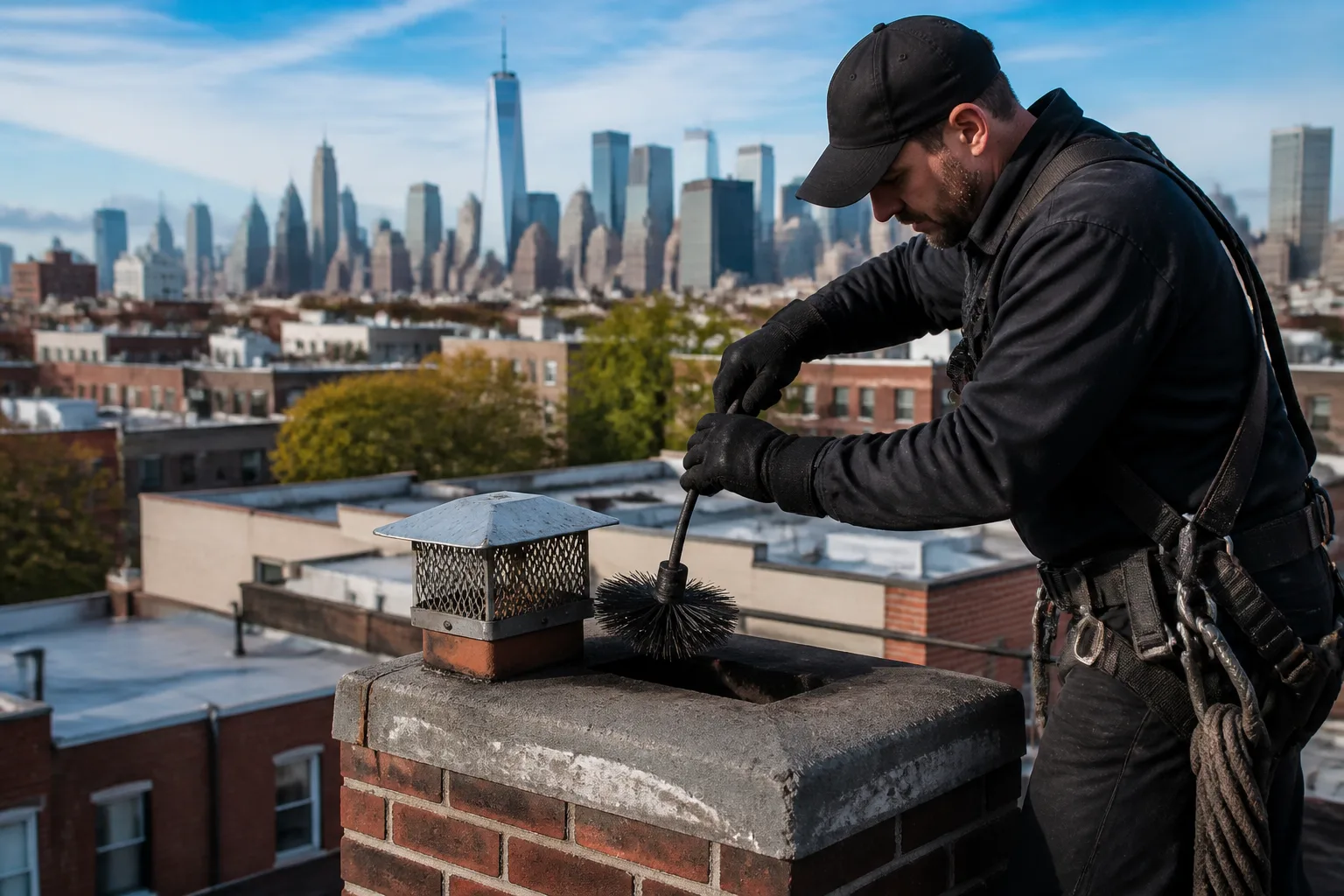
DuraFlex Chimney Sweep in New York City: A Homeowner’s Guide
Most chimney sweeps in New York City clean a DuraFlex liner the same way they clean a terracotta flue, and that’s the problem. DuraFlex’s spiral-lock corrugated seam traps creosote in ridges a straight brush rides right over, leaving behind the exact deposits that accelerate pitting. A proper DuraFlex cleaning uses a brush sized to the liner’s inner diameter, and the sweep verifies the seam is clear with a camera before writing the invoice. If you’d rather not deal with any of this, call (980) 580-8641 and we’ll handle it.
Key Takeaways
- DuraFlex liners accumulate creosote in the spiral seam first, not on flat wall sections.
- Brush diameter must match the liner’s listed inner dimension, not the old flue size.
- A post-cleaning camera image should show the seam, the cap, and zero bridging deposits.
- Warranty coverage can hinge on documented proof of correct brush size.
- New York City’s 1920s-1960s co-op and townhouse retrofits have specific liner fatigue risks.
What Most Sweeps Get Wrong About DuraFlex Liners
DuraFlex is a flexible stainless steel liner system, typically 316Ti alloy, with a corrugated wall and a spiral-lock seam that runs the full length of the flue. That seam is not a cosmetic detail. Creosote stages there first because the lock creates a micro-ledge where combustion byproducts slow down and condense. A standard poly brush with a diameter matched to the old clay flue, not the liner’s inner dimension, skims over the ridges and packs residue into the seam instead of removing it.
In our work across New York City, we regularly see liners that were “cleaned” three or four times yet still carry Class II creosote (flaky, darkened deposits) packed into the spiral lock. The homeowner paid for a sweep. The invoice says the flue was cleaned. The camera image, if one was taken at all, was pointed at the flat wall where a brush polishes a clean stripe. The seam never got touched.
What matters is not just the brush type but the fit. DuraFlex documents list inner diameters for every liner generation. A brush that’s too large can’t flex into the corrugations. A brush that’s too small leaves the seam untouched. Either way, the result is the same: a clean-looking flat wall and a loaded seam. That’s the residue that feeds a chimney fire, and it’s the residue that pits 316Ti over repeated burn cycles.
Why DuraFlex Is Everywhere in New York City Retrofit Work
New York City’s housing stock tells the story. Co-ops on the Upper West Side, townhouses in Park Slope, prewar walk-ups in Washington Heights: most of these buildings went up between 1920 and 1960 with terracotta flue tiles. Those tiles crack. When they do, a flexible stainless liner like DuraFlex is the standard retrofit because it snakes through offset flues without demolition.
That retrofit pattern means something specific for cleaning. A 1930s townhouse in Brooklyn Heights that got a DuraFlex liner in, say, 2012, has now had that liner in service for over a decade. The liner itself may be fine, but the creosote accumulation pattern inside a corrugated stainless tube is different from what the original sweep protocols assumed. The homeowner’s manual from the 1930s, if it exists, says nothing about spiral-lock seams. The cleaning needs to be done to the liner that’s actually in the flue, not the one the house was built with.
We also see liner fatigue in specific spots: the first two feet above the appliance outlet, where heat cycling is most aggressive, and the last foot before the termination cap, where New York City winters drive condensation. A camera inspection catches thinning and pitting in those zones before they become a breach. A brush-only visit does not.
If you’re in New York City and want to understand what’s actually inside your flue, start with our Chimney Sweep in New York City page. It explains what a proper sweep includes.
What a Post-Cleaning Camera Image Should Show
Here’s the standard we work to, and it’s the standard we think every homeowner in New York City should demand. After a DuraFlex liner is cleaned, the camera image should show three things:
- Seam integrity. The spiral lock should be visible as a continuous line, unbroken, with no separation between the interlocking edges. If the seam has started to open, that’s a liner replacement conversation, not a cleaning conversation.
- Cap condition. The termination cap should be centered, secured, and free of rust-through. A damaged cap lets rain into the flue, and rain plus creosote creates an acidic slurry that accelerates pitting in stainless liners.
- Absence of bridging deposits. No horizontal shelves of creosote spanning the flue diameter. Bridging is the stage where a chimney fire becomes self-sustaining, and it’s what happens when seam deposits get left behind visit after visit.
If the sweep can’t show you these images, you didn’t get a documented cleaning. You got a brush run. Clause 4 of the Haven Standard requires a photo record on every job, and that’s been our practice since 2009. The image is the receipt. Without it, you’re taking someone’s word for what happened forty feet of flue above your head.
The Warranty Clause That Kills Itself on Brush Diameter
DuraFlex’s manufacturer documentation includes language that should concern every New York City homeowner with a lined flue. The warranty covers material defects and corrosion failure, provided the liner was installed to spec and maintained to spec. That maintenance clause references cleaning with brushes appropriate to the liner’s diameter and alloy.
Here’s the catch. If a sweep uses a brush sized for a 6-inch round terracotta flue on a liner with a listed 5.5-inch inner diameter, the cleaning record is functionally meaningless. The manufacturer can point to the mismatch and deny a corrosion claim. The homeowner has an invoice that says “cleaned” and a warranty that says “void.”
We’ve pulled liners out of co-op buildings in Queens where the homeowner had five years of cleaning receipts and a liner that failed at the seam. The receipts didn’t list brush diameter. No camera images. No liner inner dimension recorded. That’s not a cleaning history. That’s a stack of paper.
When we clean a DuraFlex liner, we record the liner’s listed inner diameter, the brush size used, and the post-cleaning camera image. That’s the documentation a warranty claim needs. It’s also the documentation a homeowner in New York City should insist on, whether we’re the ones doing the work or someone else is.
How to Read a Level 2 Inspection Report for a DuraFlex Liner
NFPA 211 Level 2 inspection covers the entire flue interior with a camera, not just the first few feet visible from the fireplace opening. For a DuraFlex-lined chimney in New York City, the report should tell you whether the liner was actually assessed, not just glanced at.
Here’s what to look for:
- The liner’s inner diameter is stated. If the report doesn’t list it, the inspector didn’t measure it.
- Creosote class is named. Class I (dusty film), Class II (flaky scale), Class III (glazed, tar-like). If the report says “some buildup” without a class, it’s guesswork.
- Seam condition is noted. “Spiral lock intact” or “seam separation observed at 12 feet” tells you the inspector actually looked at the seam, which is the failure point.
- Photos or stills are attached. A Level 2 without images is a flashlight look in a hard hat. Clause 4 of the Haven Standard exists because we got tired of explaining this.
A report that says “liner appears serviceable” with no measurements, no classes, and no images didn’t assess your liner. It described a feeling. When we inspect a DuraFlex liner in New York City, the customer walks away with named conditions, measured dimensions, and a photo archive they can open on their phone. That’s the difference between an opinion and a document.
Why Brush Selection Is Not a Preference Question
There’s a persistent idea in the chimney trade that any poly brush will do. For a smooth-wall clay flue, that’s mostly true. For a corrugated stainless liner, it’s not. The brush needs to flex into the corrugations without grinding against the lock seam. That means material matters: poly or soft nylon, not steel. Steel brushes scratch stainless and create anchor points for future creosote.
Diameter matters more than material. Too small, and the seam never gets touched. Too large, and the brush compresses against the corrugations and polishes the flat surfaces while packing the seams even tighter. The correct brush diameter for a DuraFlex liner is the liner’s listed inner dimension, not the old flue dimension, and not whatever brush is on the truck.
We track liner dimensions on every visit. The next sweep sees what the last sweep saw, and the cleaning is done to the liner that’s actually in the flue. No guesswork, no “it felt right.” That’s how you prevent the slow accumulation that turns a clean liner into a Class III problem over three or four seasons.
For homeowners in New York City dealing with liner issues beyond cleaning, our Chimney Repair in New York City page covers what repair work actually involves, including liner assessment and replacement options.
What This Means for New York City Homeowners
The practical takeaway is simple. If you have a DuraFlex liner in your New York City chimney, ask the sweep three questions before they put a brush in the flue:
- What’s the liner’s inner diameter, and what brush size are you using?
- Will I get post-cleaning camera images showing the seam?
- Does your invoice document the brush size for warranty records?
If the answers are vague, the cleaning will be vague. That’s not elitism. It’s physics. A straight brush can’t clean a spiral seam, and an invoice without a diameter can’t support a warranty claim. These are the same questions we’d want answered before anyone touched our own chimney.
We’ve used materials from DuraFlex, HeatShield, and Olympia Chimney across thousands of New York City jobs. The liners are good products. But they demand a level of attention to detail that most cleaning protocols never accounted for. The good news is that the fix is simple: measure, match, clean, document. Four steps. The difference is in whether your sweep actually does them.
1,200 Words on Why Documentation Is the Whole Job
We’re going to be direct here because the stakes are direct. A chimney fire in a New York City co-op or townhouse doesn’t stay in the chimney. It spreads through the chase, reaches the roof structure, and becomes a building problem, not a unit problem. And chimney fires almost never happen in clean flues. They happen in flues where creosote was left behind, visit after visit, because no one looked at the seam.
The DuraFlex spiral-lock seam is the first place creosote stages a second-layer buildup, and it’s also the exact spot a straight brush skips. We wrote that at the top of this guide because it’s the single fact most homeowners in New York City never hear. They pay for a cleaning, they get a brush run, and the seam sits there loading up season after season. Then something happens, and the invoice says “cleaned,” and the insurance adjuster asks for the camera images, and there aren’t any.
That’s not a hypothetical. We’ve testified to it in claims we’ve consulted on. The homeowner had receipts. The sweep had no record of what they actually did. The warranty was void because the brush diameter couldn’t be documented. The entire value of a cleaning, gone, because no one wrote down a number.
Here’s what a defensible cleaning record looks like for a DuraFlex liner in New York City:
- Liner inner diameter, recorded from the manufacturer’s plate or the installation document.
- Brush type and brush diameter, recorded on the invoice.
- Creosote class before and after, named, not guessed.
- Post-cleaning camera stills showing the seam, the cap, and the full flue length.
- A written scope and a written warranty, delivered before work starts, per Clause 1 of the Haven Standard.
That’s six lines of documentation. It takes an extra four minutes. It’s the difference between a cleaning that stands up and a cleaning that evaporates the moment someone asks for proof.
We started doing camera-scan documentation as the default in 2009. Not because regulators asked for it. Not because insurers demanded it. Because our owner, Corrine Halstead, got tired of telling customers what we found without being able to show them. That practice became Clause 4 of the Haven Standard, and it’s been continuous ever since. Thirty-eight thousand chimneys inspected and cleaned since 2009, every one with a written price before work started and a documented record when it was done.
In New York City specifically, the housing stock makes this more urgent than it is elsewhere. A 1920s co-op on the Upper East Side with a DuraFlex liner retrofitted in 2010 has now had that liner through fourteen heating seasons. The seam has been through fourteen years of thermal cycling. The creosote pattern inside has been through fourteen years of condensation and re-deposit. That liner is not the same liner that went in. It needs to be assessed, not assumed.
We also see installation context that matters for cleaning. Some DuraFlex liners in New York City were installed through offset flues with heat shields and standoffs that make full camera passage difficult. Some were installed by general contractors who didn’t record the liner’s diameter on the building’s file. Some were insulated, some weren’t. The cleaning protocol changes with each variable. The only way to know which variable you have is to look, and looking means a camera.
We pulled one out of a townhouse in Astoria last fall where the previous owner had been told for years that the liner was fine. The camera showed seam separation at 14 feet, right where the flue offset. The homeowner had been burning fires in a living room with a breach they couldn’t see. The liner came out. The replacement went in. That’s the job.
Related services in New York City: if your liner is beyond cleaning and needs assessment for replacement, our Chimney Repair in New York City page explains the process. If you’re also dealing with the firebox, damper, or hearth, see Fireplace Services in New York City for what’s involved.
When to Call a Pro
If the sight of a chimney brush makes you want to check your homeowners policy, call us. But seriously: DuraFlex liner cleaning is not a DIY project. You can’t see the seam from the roof. You can’t measure creosote class by looking down a flashlight. And a liner that’s cleaned incorrectly is worse than a liner that’s left alone, because the packed seam becomes harder to clean later.
Call a pro when the liner is more than two seasons old and you don’t have camera documentation from the last cleaning. Call a pro when you hear a rumble that sounds like a distant truck, or when you smell a sharp, oily smell near the fireplace in warm weather. Those are signs that creosote is building. And call a pro when you buy a home in New York City with an existing liner and no records. The records either exist or they don’t, and if they don’t, start them now.
The Bottom Line
DuraFlex liners are solid products when they’re cleaned to their actual dimensions and documented properly. The problem is that most cleaning protocols were written for smooth-wall flues, and a spiral-lock stainless liner is a different animal. The seam is where creosote lives. The brush has to match the liner’s inner diameter. The camera image is the proof. If your sweep in New York City can’t show you the seam after cleaning, they didn’t clean the seam. If you’re in New York City and need help, Emberly Chimney Cleaners offers free estimates - call (980) 580-8641. We’ll put a camera down your flue, show you what’s there, and give you a written price before anyone touches anything.
Frequently Asked Questions
Chimney cleaning for a DuraFlex-lined flue in New York City typically runs $250 to $450 depending on liner length, creosote class, and access. That should include a camera inspection and photo documentation. If someone quotes you $99, ask what the brush diameter is. Then ask for the camera images. If you’re in New York City, call (980) 580-8641 for an exact written quote - estimates are free.
Every 30 to 50 burn cycles, or once per burning season if you use the fireplace more than twice a week. The corrugated seam collects creosote faster than a smooth flue, so a once-a-year cleaning for regular users in New York City is the safe baseline. If you burn green wood or have a wood stove, clean more often.
We don’t recommend it. The spiral-lock seam requires a brush sized to the liner’s listed inner diameter, and you can’t verify the seam is clear without a camera. Incorrect brushing packs creosote into the seam and can void your warranty. If you want to know what’s happening in your flue, call a pro. If you want to watch, that’s fine too. We’ll show you the images.
No. Stainless liners still accumulate creosote, and the corrugated wall actually gives creosote more surface to grip. A liner contains the flame and protects the masonry, but it doesn’t stop the buildup. Regular cleaning with the correct brush size is still required. Call (980) 580-8641 for an exact quote - estimates are free, and we’ll show you the images before and after.
Written by Corrine Halstead, Owner at Emberly Chimney Cleaners, serving New York City since 2009.
Need Chimney Cleaning Help?
Call Emberly Chimney Cleaners - licensed & insured, here with fast after-hours help in Pasadena.
(980) 580-8641